

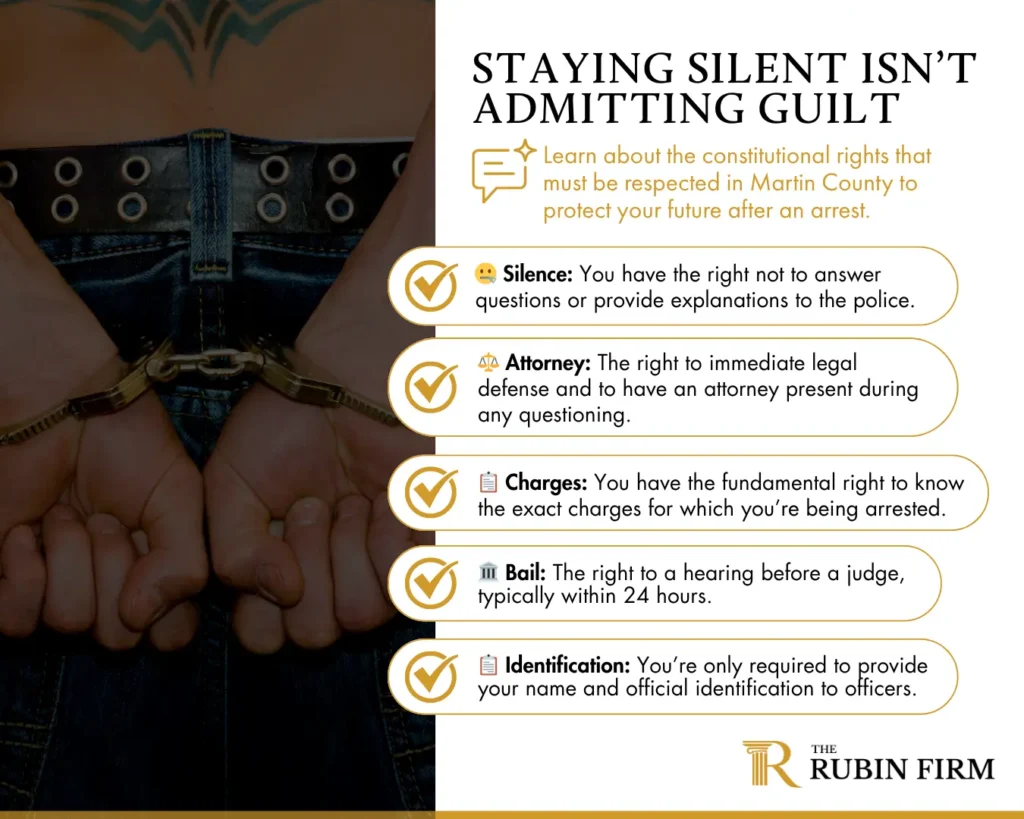
If you are arrested in Martin County, Florida, you have constitutional rights that law enforcement must respect throughout the process. You have the right to remain silent, the right to an attorney, the right to know the charges against you, and the right to a bond hearing before a judge, typically within 24 hours of your arrest. You are not required to answer questions beyond providing your name and identification, and anything you say to law enforcement can be used against you in court. Exercising these rights is not an admission of guilt. It is the single most important step you can take to protect your future. Under the Nineteenth Judicial Circuit, which covers Martin, St. Lucie, Indian River, and Okeechobee counties, criminal cases follow specific local procedures that an experienced defense attorney will know how to navigate.
Keep reading to learn what happens at each stage of the arrest and booking process, how to protect yourself from self-incrimination, and why having an attorney early in the process matters. If you or a family member has been arrested, the criminal defense attorneys at The Rubin Firm in Stuart can help immediately.
Key Takeaways
- You have the right to remain silent. Use it. Do not volunteer information, explain your side of the story, or try to talk your way out of the situation.
- You have the right to an attorney. Request one clearly and immediately. Once you do, law enforcement must stop questioning you.
- A bond hearing typically occurs within 24 hours of your arrest in Martin County. An attorney can advocate for a lower bond or release on your own recognizance.
- What you say and do after an arrest matters. Conversations with cellmates, phone calls from the jail, and social media activity can all be used as evidence against you.
Your Constitutional Rights During an Arrest
The Fifth Amendment protects you from self-incrimination, and the Sixth Amendment guarantees your right to legal counsel. When an officer places you under arrest, they are required to read you your Miranda rights before conducting a custodial interrogation. These rights include the right to remain silent, the warning that anything you say can be used against you in court, the right to have an attorney present during questioning, and the right to a court-appointed attorney if you cannot afford one.
Here is what many people do not realize: you do not have to wait for the Miranda warning to exercise your rights. From the moment you interact with law enforcement, you can choose not to answer questions. Politely state that you are invoking your right to remain silent and that you would like to speak with an attorney. Then stop talking. Nervous explanations, apologies, and attempts to “clear things up” are some of the most damaging things you can do at this stage.
What Happens After an Arrest in Martin County
After an arrest, you will be transported to the Martin County Jail on SE Monterey Road in Stuart for booking. The booking process includes photographing, fingerprinting, recording your personal information, and conducting a search of your belongings. You will be given the opportunity to make a phone call. Use it wisely. Call a family member or attorney, not someone who might complicate your case.
Be aware that phone calls from the Martin County Jail are recorded, with the exception of calls to your attorney. Do not discuss the facts of your case over the phone with anyone other than your lawyer. Conversations with cellmates are not privileged either, and it is not uncommon for jailhouse informants to relay information to prosecutors in exchange for favorable treatment in their own cases.
The Bond Hearing and Getting Released
Florida law requires that you be brought before a judge for a first appearance hearing within 24 hours of your arrest. At this hearing, the judge reviews the charges against you, advises you of your rights, and determines the conditions of your release. The judge may set a monetary bond, release you on your own recognizance, or in serious cases, hold you without bond.
The amount of your bond depends on the severity of the charges, your criminal history, your ties to the community, and whether the court views you as a flight risk or a danger to public safety. Having a Martin County criminal defense attorney present at your first appearance hearing can make a significant difference. Your attorney can argue for a reduced bond, present evidence of your community ties and employment, and address the judge’s concerns directly. Without representation, you are navigating a high-stakes proceeding on your own while dealing with the stress and disorientation of being in custody.
Common Mistakes to Avoid After an Arrest
The hours and days after an arrest are when most people make decisions that hurt their cases. Beyond speaking to law enforcement without an attorney present, other costly mistakes include posting about the arrest or the underlying incident on social media, contacting the alleged victim or witnesses in the case, failing to appear at court hearings, and ignoring the conditions of your release. Violating a no-contact order or the terms of your bond can result in your bond being revoked and your return to jail.
Resist the urge to discuss the details of your case with friends or family beyond what is necessary. These individuals can be subpoenaed as witnesses and compelled to testify about what you told them. The only person with whom your communications are legally protected is your attorney.
Protect Your Rights and Your Future Starting Now
Being arrested is frightening, but it does not define your future. You are presumed innocent until proven guilty, and the prosecution bears the burden of proving every element of the charge beyond a reasonable doubt. The criminal defense attorneys at The Rubin Firm have protected the rights of individuals facing charges in Martin County and across the Treasure Coast for over sixty years. We know the local courts, the local judges, and the defense strategies that make a difference.
If you or a loved one has been arrested, do not wait. Call us at (772) 283-2004, fill out our online contact form, or start a live chat on our website. Your consultation is free and confidential.
Frequently Asked Questions
How quickly should I hire a criminal defense attorney after an arrest?
Immediately. The earlier an attorney is involved, the more they can do to protect your rights. An attorney can be present at your first appearance hearing, communicate with prosecutors on your behalf, and begin investigating the case before evidence is lost or witnesses become unavailable.
Can I be arrested without a warrant in Florida?
Yes. Florida law permits warrantless arrests when an officer has probable cause to believe a felony has been committed, when a misdemeanor is committed in the officer’s presence, or under certain domestic violence provisions. However, the arrest must still be supported by sufficient facts, and the legality of a warrantless arrest can be challenged by your attorney.
What if I cannot afford a bond?
If the judge sets a bond you cannot afford, you have two options. A bail bondsman will typically post the full bond on your behalf for a non-refundable fee of 10% of the bond amount. Alternatively, your attorney can file a motion for bond reduction, presenting evidence to the court that a lower bond is appropriate given your financial circumstances and ties to the community.
Will my arrest appear on a background check?
An arrest record can appear on background checks even if you are never convicted. However, Florida law allows you to petition the court to seal or expunge your arrest record in certain circumstances, particularly if the charges were dropped, dismissed, or resulted in an acquittal. Eligibility depends on the specific charge and your criminal history.
What is an arraignment, and when does it happen?
An arraignment is the court proceeding where you formally enter a plea of guilty, not guilty, or no contest to the charges against you. In Martin County, arraignments typically occur within 30 days of the arrest for misdemeanors and within a similar timeframe for felonies. Your attorney will advise you on the appropriate plea and overall defense strategy before this hearing.