
and a permanent criminal record that affects your employment, housing, education, and personal life for decades. Prosecutors in Martin County do not treat drug possession as a minor matter, and neither should you. But a possession charge is also one of the most defensible categories of criminal offense, because the prosecution must prove not just that drugs existed but that you knowingly possessed them, and that the evidence was obtained through constitutionally valid means. A Stuart drug possession lawyer at The Rubin Firm challenges every element of the prosecution’s case, from the legality of the search to the credibility of the state’s evidence to the viability of diversion or treatment alternatives that can keep a conviction off your record.
Protect your future by speaking with an attorney before you speak to anyone else. Call The Rubin Firm at (772) 283-2004, fill out our contact form, or start a live chat.
Actual Possession vs. Constructive Possession in Florida
Florida law recognizes two forms of drug possession, and the distinction between them is one of the most important concepts in drug defense. Under Florida Statutes Section 893.13, it is illegal to possess a controlled substance unless authorized by law. Actual possession means the drug was found on your person, in your hand, in your pocket, or in a container you were physically carrying. In these cases, proving knowledge and control is relatively straightforward for the prosecution.
Constructive possession is far more complex and far more defensible. Constructive possession means the drugs were not found on your person but in a location you allegedly had access to or control over, such as your vehicle, your home, a shared apartment, or your workplace. To prove constructive possession, the prosecution must establish two things beyond a reasonable doubt: that you knew the drugs were present, and that you had the ability to exercise dominion and control over them.
This standard creates a powerful defense in many common scenarios. When police find drugs during a traffic stop in a car with multiple occupants, the prosecution cannot simply charge everyone in the vehicle. They must prove which occupant or occupants knew about the drugs and had control over them. When drugs are found in a shared residence or apartment, the prosecution must prove that the specific defendant had knowledge and control, not just that they lived there. These evidentiary hurdles are real, and a skilled defense attorney exploits them aggressively.
Penalties for Drug Possession in Florida

The penalties for drug possession in Florida vary based on the type of substance and the quantity involved. Even at the misdemeanor level, a conviction creates lasting consequences.
Marijuana (under 20 grams)
First-degree misdemeanor. Up to 1 year in jail, $1,000 fine, and a 2-year driver’s license suspension.
Marijuana (20 grams or more)
Cocaine, heroin, methamphetamine, and other Schedule I/II substances
Third-degree felony for simple possession. Up to 5 years in prison and $5,000 fine.
Prescription drugs without a valid prescription
Possession with intent to sell
If the prosecution can prove intent to distribute, the charge escalates to a second-degree felony carrying up to 15 years in prison and a $10,000 fine. Factors like packaging materials, scales, large quantities of cash, and distribution-quantity packaging can be used to argue intent.
Collateral consequences
Every drug conviction triggers an automatic 2-year driver’s license suspension regardless of whether driving was involved. Federal financial aid eligibility is affected. Employment background checks will reveal the conviction. Immigration consequences for non-citizens can include deportation.
injured? Let Us Help You Get Justice. Free consultation. No fees unless we win your case.
Why The Rubin Firm Defends Drug Possession Aggressively
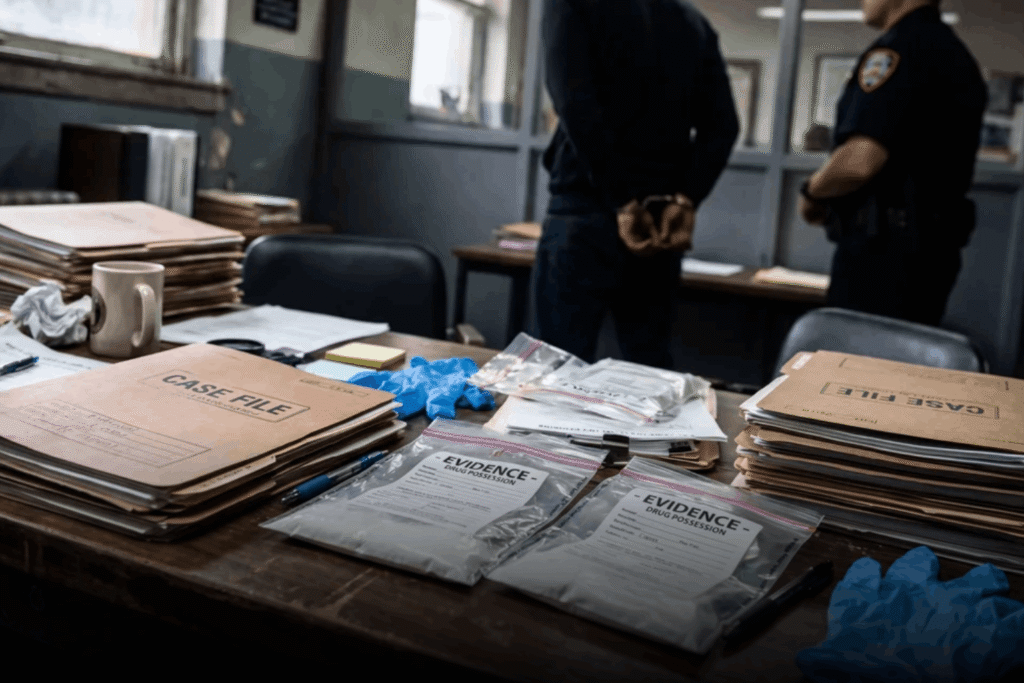
Possession cases are among the most winnable categories of criminal defense because the prosecution’s burden of proof is high and the opportunities to challenge the evidence are numerous. At The Rubin Firm, we approach every possession case with the goal of getting the charge dismissed, reduced, or diverted, and we prepare for trial when the facts support a fight.
Motion to suppress evidence
Challenging knowledge and control
In constructive possession cases, we challenge the prosecution’s ability to prove you knew the drugs were present and had control over them. Proximity is not possession.
Substance identification
We verify that the substance was properly tested by an accredited laboratory and that the chain of custody from seizure to testing was maintained. Field test kits used by officers are notoriously unreliable, having produced false positives for legal substances ranging from chocolate to vitamins.
Diversion and drug court
Plea negotiation
When diversion is not available, we negotiate with prosecutors for reduced charges, withholding of adjudication (which avoids a formal conviction on your record), and alternative sentencing that emphasizes treatment over incarceration.
Common Scenarios That Lead to Possession Charges in Stuart
Prescription medication:
Possessing even a single prescription pill without a valid prescription is a felony in Florida. Individuals who borrow medication from a family member or carry pills without their prescription bottle can face serious charges.
Drug possession charges in Martin County arise from a predictable set of circumstances, each with its own set of defense opportunities. Understanding how your case originated helps shape the most effective defense strategy.
Traffic stops on I-95 and U.S. Route 1:
Officers stop vehicles for traffic violations and then attempt to develop grounds for a search. Consent requests, claimed odor of marijuana, drug-detection dogs, and vehicle inventories are all common pretexts. Each creates potential constitutional challenges.
Search incident to arrest:
When police arrest someone for another offense, they conduct a search of the person and the area within their immediate reach. Drugs found during these searches may be challenged if the underlying arrest was invalid.
Probation and parole searches:
Individuals on probation or parole may be subject to warrantless searches as a condition of supervision. However, even these searches have limits, and evidence found outside the scope of a lawful supervision search can be challenged.
Shared vehicles and residences:
Drugs found in a car with multiple passengers or in a home shared by roommates frequently result in possession charges against all occupants. The constructive possession defense is particularly strong in these situations.
The Automatic Driver's License Suspension
One of the most overlooked consequences of a drug conviction in Florida is the automatic two-year suspension of your driver’s license under Florida Statutes Section 322.055. This suspension applies to every drug conviction, whether it is a misdemeanor marijuana possession or a felony cocaine charge, and whether or not the offense had any connection to driving. For many defendants, particularly those who live in suburban or rural areas of Martin County where public transportation options are limited, losing a driver’s license for two years creates a cascading set of problems: inability to get to work, inability to transport children, inability to attend medical appointments, and the temptation to drive on a suspended license, which is itself a criminal offense.
Avoiding a conviction, whether through dismissal, diversion, withholding of adjudication, or acquittal, is the only reliable way to prevent this automatic suspension. This is one of the many reasons why fighting a drug possession charge, even a seemingly minor one, is so important.
Drug Possession and Your Criminal Record
A drug conviction on your record does not simply fade away after you complete your sentence. Florida law treats drug convictions as permanent entries on your criminal history unless you successfully obtain an expungement or record sealing. Background checks conducted by employers, landlords, educational institutions, professional licensing boards, and government agencies will reveal the conviction. In a competitive job market, a drug conviction can be the single factor that disqualifies you from employment, regardless of your qualifications, your work ethic, or how long ago the conviction occurred.
For students, a drug conviction can result in the loss of federal financial aid eligibility. For professionals with state-issued licenses, a conviction can trigger disciplinary proceedings that result in license suspension or revocation. For non-citizens, even a misdemeanor drug conviction can have devastating immigration consequences, including deportation, denial of naturalization, and inadmissibility for re-entry to the United States.
Steps to Take After a Drug Possession Arrest
Exercise your right to remain silent:
Do not explain, minimize, or discuss the drugs with law enforcement. Every word you say can be used against you.
Do not consent to searches:
Remember the details:
As soon as possible, write down everything you remember about the encounter: what officers said, what they did, whether you consented, where they searched, and how the drugs were discovered.
Contact The Rubin Firm:
The sooner we can review the circumstances of your arrest, the more effectively we can protect your rights. Call (772) 283-2004.
Drug Court and Diversion: Avoiding a Conviction
For many drug possession defendants, the most important question is not whether they can win at trial but whether they can avoid a conviction altogether. Florida’s drug court and pre-trial diversion programs offer eligible defendants the opportunity to complete a structured program of substance abuse treatment, random drug testing, regular court appearances, and community requirements in exchange for having their criminal charges dismissed upon successful completion.
Drug court in Martin County operates as a therapeutic court that focuses on rehabilitation rather than punishment. Participants work with a team that includes the judge, a prosecutor, a defense attorney, substance abuse counselors, and probation officers to address the underlying addiction that led to the criminal charge. The program typically lasts 12 to 18 months and includes multiple phases of progressively less intensive supervision. Participants who comply with every requirement and complete the program have their charges dismissed, and in many cases the arrest itself becomes eligible for expungement, meaning it can be erased from their criminal record entirely.
Pre-trial diversion is a similar concept but typically involves a shorter program with less intensive supervision. Eligible defendants agree to complete specific conditions, which may include community service, substance abuse evaluation and treatment, random drug testing, and a period of supervision. Upon successful completion, the State Attorney’s Office dismisses the charges. Not every defendant qualifies for drug court or diversion. Eligibility depends on the nature of the charge, criminal history, and other factors. The Rubin Firm evaluates every client’s eligibility and advocates aggressively for admission to these programs when they represent the best outcome for the client.
Withholding of Adjudication: A Second Path to Protection
Even when dismissal or diversion is not available, there may still be a path that avoids the full consequences of a conviction. Florida law allows judges to withhold adjudication of guilt in certain cases. When adjudication is withheld, the defendant enters a plea or is found guilty, but the court does not formally adjudicate them as a convicted felon. This distinction matters enormously for collateral consequences. A person who receives a withhold of adjudication generally avoids some of the automatic penalties that attach to a formal conviction, and may become eligible for record sealing rather than the full expungement process.
However, a withhold of adjudication does not prevent the driver’s license suspension that accompanies drug offenses, and it does not eliminate all collateral consequences. It is a middle-ground outcome that can be valuable when the alternatives are worse, but it should not be treated as equivalent to a dismissal or acquittal. The Rubin Firm evaluates whether a withhold of adjudication serves the client’s interests in light of the specific facts and the full range of consequences the client faces.
We’re Here To Heil You Recover Compensation For:
- Injury or damages
- Injury & Medical
- Injury or damages
Serving Stuart, Martin County, and the Treasure Coast
The Rubin Firm defends individuals facing drug possession charges in Stuart, Palm City, Jensen Beach, Hobe Sound, Indiantown, Port St. Lucie, Fort Pierce, Vero Beach, Jupiter, and throughout Martin, St. Lucie, Indian River, and Palm Beach Counties.
Referral Partnerships for Drug Possession Cases
Attorneys across the Treasure Coast trust The Rubin Firm for drug possession defense referrals. Contact us to discuss a referral.
Frequently Asked Questions About Drug Possession in Stuart
Is drug possession a felony in Florida?
Possession of marijuana under 20 grams is a first-degree misdemeanor. Possession of marijuana over 20 grams and possession of all other controlled substances is a third-degree felony carrying up to 5 years in prison. Possession with intent to sell is a second-degree felony carrying up to 15 years.
What is constructive possession?
Constructive possession means drugs were found in a location you had access to or control over, rather than directly on your person. The prosecution must prove you knew the drugs were present and had the ability to exercise dominion and control over them. Being in proximity to drugs in a shared space is not sufficient proof.
Can a drug possession charge be dismissed?
Yes. Charges can be dismissed if evidence is suppressed due to an illegal search, if the prosecution cannot prove knowledge and control in a constructive possession case, if the substance was not properly tested, or if you successfully complete a drug court or diversion program.
Will I lose my driver’s license for a drug possession conviction?
Yes. Florida law mandates an automatic two-year driver’s license suspension for any drug conviction, regardless of whether the offense involved driving.
Can a drug possession conviction be expunged?
In some cases, yes. If your charges are dismissed or you complete a diversion program, you may be eligible for expungement of the arrest record. If you received a withhold of adjudication, you may be eligible for record sealing. An attorney can evaluate your specific eligibility.
$150 Million
A Possession Charge Is Not a Conviction. Fight Back.
The prosecution must prove every element of its case beyond a reasonable doubt, and drug possession cases are full of opportunities to challenge the evidence. The Stuart drug possession lawyers at The Rubin Firm fight to protect your freedom, your record, and your future.
Call (772) 283-2004 for a confidential consultation. Complete our contact form or chat live. We defend your rights.
 4.9 Rating on