
A Stuart motorcycle accident lawyer at The Rubin Firm understands the unique legal and practical challenges riders face after a crash. Unlike car accident claims, motorcycle injury cases in Florida do not involve Personal Injury Protection (PIP) benefits, meaning injured riders must pursue compensation directly against the at-fault driver under Florida’s negligence laws. Our attorneys fight rider bias, build evidence-driven cases, and pursue the full value of every claim.
Learn how Florida motorcycle accident claims work and what steps you can take to protect your rights. Call The Rubin Firm at (772) 283-2004, complete our online contact form, or start a live chat. Your initial consultation is free.
Why Riders Trust The Rubin Firm After a Motorcycle Crash

Insurance companies and juries sometimes harbor an unfair bias against motorcyclists. There is a deeply rooted assumption in some quarters that riders are reckless thrill-seekers who accept the risk of injury every time they throw a leg over a bike. That prejudice can poison every stage of a claim, from the initial adjuster evaluation all the way through jury deliberations if a case goes to trial. It is one of the most persistent challenges in motorcycle accident litigation, and it requires an attorney who knows how to confront it head-on.
At The Rubin Firm, we build motorcycle accident cases that are anchored in evidence, supported by expert testimony, and framed by compelling narrative. We do not let stereotypes drive the conversation. When a negligent driver causes a crash, that driver bears responsibility for the consequences. Full stop. Our job is to make sure the evidence tells that story clearly and persuasively.
We also understand the medical complexity of motorcycle injuries. Road rash, for example, is far more than a skin abrasion. Severe road rash can involve deep tissue damage, muscle and tendon exposure, nerve injury, and infections that require weeks of treatment and leave permanent scarring. Insurance adjusters who try to minimize these injuries learn quickly that we will not accept their characterizations.
We know the roads
Stuart’s coastal highways, residential neighborhoods, and the I-95 corridor create specific hazards for Martin County riders. We use that local knowledge to investigate crash scenes and establish how negligent drivers created dangerous conditions.
We fight rider bias
Contingency representation
You pay nothing upfront. We only collect a fee if we recover compensation on your behalf.
Trial-tested attorneys
injured? Let Us Help You Get Justice. Free consultation. No fees unless we win your case.
Common Causes of Motorcycle Accidents in Martin County

Rear-end collisions:
A motorcyclist stopped at a light or crawling in traffic is struck from behind by a driver who failed to stop in time.
Road hazards:
Potholes, loose gravel, oil slicks, sand, uneven pavement, and road debris that a car might drive over without incident can be deadly for a motorcycle. Government entities and construction contractors may be liable for failing to maintain safe road conditions.
Dooring:
In Stuart’s downtown and commercial areas, drivers and passengers who swing open car doors into a cyclist’s lane of travel cause sudden, violent crashes that can throw riders from their bikes.
The Florida DHSMV tracks crash data statewide, and the numbers tell a consistent story: the majority of multi-vehicle motorcycle crashes are caused by the other driver’s negligence, not the rider. Data from the National Highway Traffic Safety Administration (NHTSA) reinforces that finding, showing that a significant percentage of fatal motorcycle crashes involve another vehicle that violated the motorcyclist’s right of way.
Left-turn collisions are among the deadliest scenarios for motorcyclists. A car driver waiting to turn left across oncoming traffic fails to see an approaching motorcycle, either because the bike presents a smaller visual profile or because the driver simply is not looking for it, and turns directly into the rider’s path. The physics of these crashes are brutal. The rider often has a fraction of a second to react and strikes the turning vehicle at or near full speed. The results are frequently catastrophic.
Rear-end collisions represent another persistent danger, particularly in stop-and-go traffic on U.S. Route 1 and at traffic lights throughout Stuart. A car driver who is distracted, following too closely, or simply not paying attention can slam into a motorcycle stopped at a red light or in slow traffic. Without the protective cage of a car surrounding them, the rider absorbs the full impact.
Left-turn accidents:
A driver fails to see an oncoming motorcycle and turns directly into the rider’s path, producing some of the most catastrophic injuries in all of motor vehicle litigation.
Lane-change collisions:
Motorists fail to check blind spots before merging, sideswiping motorcycles traveling alongside them. Bikes are smaller and can fall into blind spots that would not hide a car.
Distracted and impaired drivers:
Texting, phone use, GPS adjustments, and intoxication reduce a driver’s ability to detect motorcycles sharing the road. A distracted driver who does not see a car will not see a motorcycle either.
Injuries Common in Motorcycle Accidents
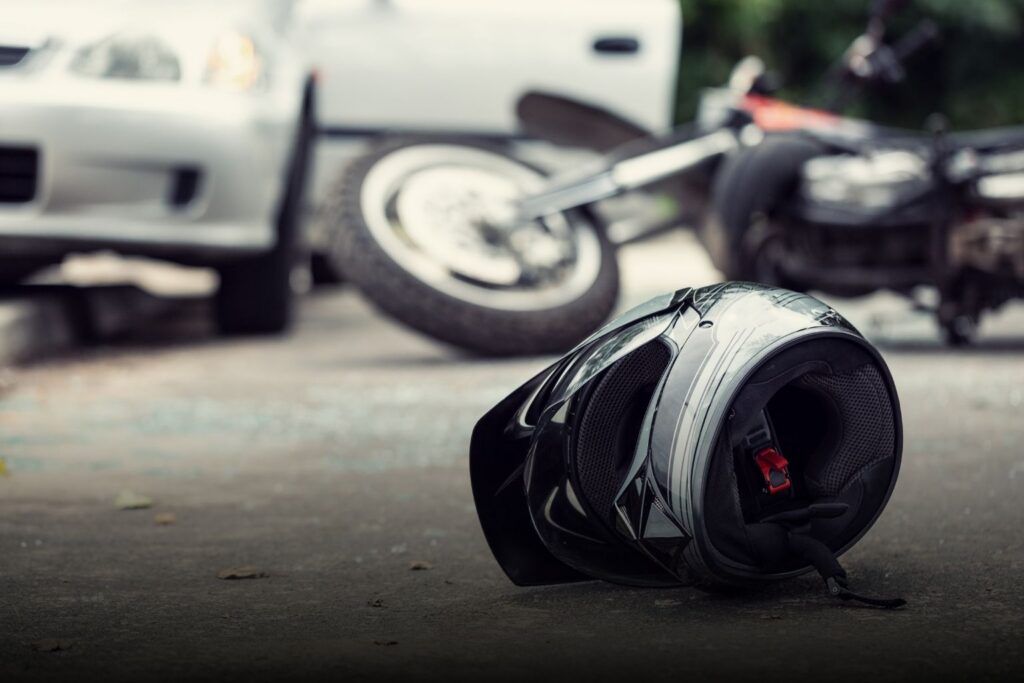
The human body absorbs tremendous force in a motorcycle crash. Even with proper protective gear, including DOT-rated helmets, armored jackets, reinforced gloves, and riding boots, injuries are often severe and life-altering. The absence of a protective vehicle frame means the rider’s body becomes the primary point of impact with the other vehicle, the road surface, and any fixed objects in the crash path.
The pattern of injury in motorcycle crashes is distinctive and well-documented in trauma medicine. The initial impact typically strikes the lower extremities, causing leg and pelvic fractures. The rider is then separated from the bike, sustaining head, torso, and upper extremity injuries upon landing or sliding. Road rash from contact with the pavement can strip away skin and underlying tissue across large areas of the body. Each of these injury mechanisms can produce long-term or permanent consequences.
Traumatic brain injuries
The leading cause of motorcycle fatalities nationwide. Florida allows riders over 21 with qualifying insurance to ride without a helmet under state law, but even helmeted riders can sustain concussions and more severe brain injuries from the violent forces involved in a crash.
Spinal cord injuries and paralysis
Road rash and degloving injuries
Fractures and crush injuries
Legs trapped between the motorcycle and the other vehicle, shattered collarbones from impact with the ground, broken wrists and arms from bracing for impact, and pelvic fractures are all extremely common.
Internal organ damage
Blunt force trauma can cause internal bleeding, ruptured spleens, liver lacerations, and kidney damage that may not present obvious symptoms immediately at the crash scene.
Amputation
Severe crush injuries to limbs, particularly legs caught between the motorcycle and another vehicle or dragged along the roadway, sometimes require surgical amputation.
Florida Motorcycle Insurance and Negligence Laws
One of the most important legal distinctions for motorcyclists in Florida is the absence of PIP coverage requirements. Under Florida Statutes Section 316.211, motorcycle operators are exempt from the state’s no-fault insurance requirements. This means injured riders cannot rely on their own PIP coverage to pay initial medical bills. Instead, they must pursue compensation through the at-fault driver’s bodily injury liability insurance, making the determination of fault central to the case from the very first day.
This legal distinction makes motorcycle accident claims fundamentally different from car accident claims in Florida. In a car crash, PIP coverage provides a baseline of medical benefits regardless of fault. Motorcycle riders do not have that safety net. If the at-fault driver’s insurance company disputes liability or tries to minimize the claim, the rider can be left facing enormous medical bills with no source of interim payment.
Florida’s comparative negligence system, governed by Florida Statutes Section 768.81, allows injured riders to recover damages even if they share some fault for the crash. Compensation is reduced proportionally by the rider’s percentage of responsibility. An experienced motorcycle accident attorney works to minimize any fault attributed to the rider, particularly when insurance companies try to exploit rider bias to inflate the rider’s share of responsibility.
Florida law also allows riders over 21 who carry at least $10,000 in medical payment coverage to ride without a helmet. While this is a lawful choice, insurance companies frequently attempt to use helmet non-use against riders in injury claims, arguing that the absence of a helmet contributed to or worsened head injuries. An experienced attorney can counter this tactic with medical evidence that demonstrates the actual mechanism and cause of the injuries sustained.
Compensation for Motorcycle Accident Victims in Stuart
Because motorcycle injuries tend to be severe and often permanent, the compensation available in these cases is frequently substantial. A motorcycle accident attorney in Stuart at The Rubin Firm evaluates every available source of recovery, including the at-fault driver’s bodily injury liability insurance, the rider’s own uninsured/underinsured motorist (UM/UIM) coverage, and any other applicable insurance policies.
Medical treatment and rehabilitation
Lost income and earning capacity
Pain and suffering
Property damage
Loss of consortium
Steps to Take After a Motorcycle Crash in Stuart
What you do in the immediate aftermath of a motorcycle crash can significantly influence the strength of your legal claim. If you are physically able, the following steps will help protect both your health and your right to compensation.
Get medical treatment immediately:
Your health is the absolute priority. Seek emergency medical care even if your injuries seem manageable at the scene. Adrenaline can mask serious conditions, and some injuries, particularly internal bleeding and brain injuries, may not present obvious symptoms for hours.
Do not give recorded statements:
Do not provide a recorded statement to any insurance company before consulting with an attorney. Insurance adjusters are professionally trained to elicit statements that can be used to reduce or deny your claim.
Call law enforcement:
Contact The Rubin Firm:
Preserve your gear and evidence:
Keep your damaged helmet, riding jacket, gloves, boots, and all clothing. Do not repair, discard, or alter anything. Photograph the crash scene, vehicle positions, road conditions, debris, traffic controls, your injuries, and the other driver’s vehicle from multiple angles.
We’re Here To Heil You Recover Compensation For:
- Injury or damages
- Injury & Medical
- Injury or damages
Serving Riders Across Stuart, Martin County, and the Treasure Coast
The Rubin Firm represents injured motorcyclists in Stuart, Palm City, Jensen Beach, Hobe Sound, Indiantown, Port St. Lucie, Fort Pierce, Vero Beach, Jupiter, and throughout Martin County, St. Lucie County, Indian River County, and Palm Beach County. Our attorneys know the roads where motorcycle accidents happen, the courts where these cases are litigated, and the insurance companies that handle claims in this region.
Frequently Asked Questions About Stuart Motorcycle Accidents
Are motorcycle accident claims handled differently from car accident claims in Florida?
Yes, and the differences are significant. Motorcyclists are not covered by PIP insurance in Florida, which means injured riders pursue compensation directly through the at-fault driver’s insurance. There is no no-fault safety net to cover initial medical bills. This makes establishing fault and proving the other driver’s negligence the central focus of every motorcycle claim from day one.
Can the insurance company reduce my claim because I was not wearing a helmet?
Florida law allows riders over 21 with qualifying medical coverage to ride without a helmet. While insurance companies sometimes argue that helmet non-use contributed to or worsened head injuries, an experienced attorney can counter this argument with medical evidence establishing the actual nature and mechanism of the injuries sustained.
How long do I have to file a motorcycle accident lawsuit in Florida?
The statute of limitations for personal injury claims in Florida is generally two years from the date of the accident. Wrongful death claims carry a two-year deadline from the date of death. Missing these deadlines bars your claim entirely, and critical evidence may be lost if you wait too long to involve an attorney.
What if I was partially at fault for the crash?
Florida’s comparative negligence system allows you to recover compensation even if you share some fault. Your award is reduced by your percentage of responsibility. An experienced attorney works to minimize the fault attributed to you and to counter the rider bias that insurance companies sometimes exploit.
What should I do if the at-fault driver’s insurance coverage is insufficient?
Uninsured and underinsured motorist (UM/UIM) coverage on your own auto or motorcycle policy can bridge the gap when the at-fault driver’s coverage is not enough to compensate you fully. We review all available policies to identify every source of recovery and maximize your total compensation.
$150 Million
Injured in a Motorcycle Crash? We Ride for You.
The Stuart motorcycle accident lawyers at The Rubin Firm are ready to fight for riders who have been harmed by negligent drivers. We bring experience, determination, and a deep respect for the motorcycling community to every case.
Call (772) 283-2004 for a free consultation. Complete our contact form or chat live on our website. There is no fee unless we win your case.
 4.9 Rating on