



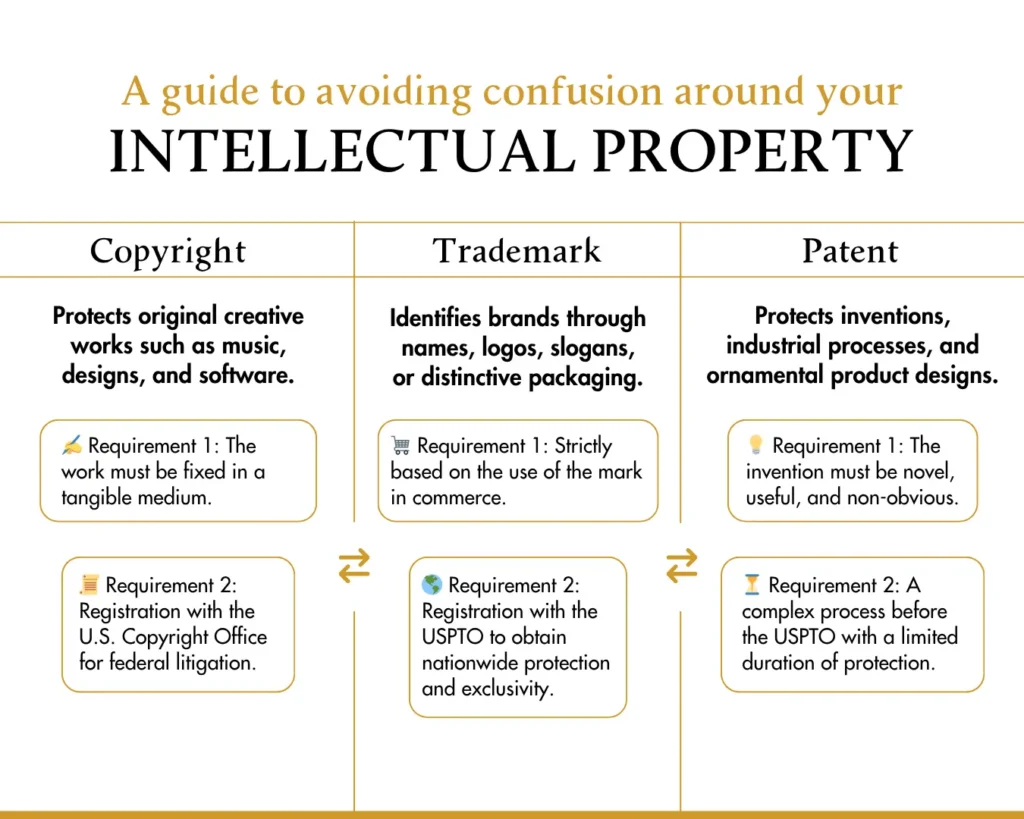
Copyrights, trademarks, and patents protect three different types of intellectual property. Copyrights protect original creative works such as written content, music, software code, and visual designs. Trademarks protect brand identifiers like business names, logos, and slogans that distinguish your products or services in the marketplace. Patents protect inventions, processes, and unique designs. Each form of protection has its own registration process, duration, and enforcement mechanisms, and many Florida businesses need more than one. Understanding which type applies to your specific assets is the first step toward building an intellectual property strategy that protects your competitive advantage. The United States Patent and Trademark Office and the U.S. Copyright Office administer the federal registration systems for each.
Read on to learn how each form of IP protection works, the common situations where Florida business owners need them, and why getting this right early saves money and headaches down the road. The intellectual property attorneys at The Rubin Firm in Stuart help businesses across Florida identify and protect their most valuable intangible assets.
Key Takeaways
- Copyrights protect what you create. Original written content, music, artwork, software, photographs, and videos are all copyrightable from the moment of creation.
- Trademarks protect how you identify your business. Your business name, logo, slogan, and other brand identifiers distinguish you from competitors.
- Patents protect what you invent. A new product, process, machine, or design that is novel, useful, and non-obvious may qualify for patent protection.
- Many businesses need more than one type of IP protection. A software company, for example, may need copyrights for its code, trademarks for its brand, and patents for its proprietary technology.
Copyright: Protecting Your Creative Work
Copyright protection applies to original works of authorship fixed in a tangible medium of expression. For Florida business owners, that covers a wide range of assets: your website content, marketing materials, photographs, product descriptions, training manuals, software code, music, videos, and graphic designs. Copyright protection is automatic the moment the work is created, which means you do not need to register to own the copyright. However, registration with the U.S. Copyright Office provides critical legal advantages, including the ability to file a federal infringement lawsuit and seek statutory damages and attorney’s fees.
Copyright protection generally lasts for the life of the author plus 70 years. For works created by employees within the scope of their employment (known as “works made for hire”), the copyright belongs to the employer, and protection lasts for 95 years from publication or 120 years from creation, whichever comes first. This distinction matters for businesses that rely on content created by staff or contractors. If you hire a freelance graphic designer to create your logo, the question of who owns the copyright depends on the terms of your agreement. Without a written work-for-hire contract or assignment, the freelancer may retain ownership of the work.
Trademark: Protecting Your Brand Identity
A trademark is any word, phrase, symbol, design, or combination that identifies and distinguishes your products or services from those of others. Your business name, logo, slogan, product names, and even distinctive packaging or color schemes can serve as trademarks. Unlike copyrights, trademark rights in the United States are based on use in commerce, not creation. The first business to use a mark in connection with specific goods or services in a particular geographic area generally has priority over later users.
Federal registration through the USPTO takes that protection nationwide. A registered trademark gives you the legal presumption of ownership, the exclusive right to use the mark in connection with the goods and services listed in the registration, and the ability to bring an infringement action in federal court. Registration also allows you to use the ® symbol, which signals to competitors and the public that your mark is federally protected. Florida businesses that serve customers online or plan to expand beyond the state’s borders benefit significantly from federal registration. Your Florida trademark registration attorney can conduct a trademark search, evaluate your mark’s strength, and manage the registration process from start to finish.
Patent: Protecting Your Inventions and Innovations
A patent grants the inventor the exclusive right to make, use, sell, or import an invention for a limited period. Utility patents, which cover new and useful processes, machines, manufactured items, or compositions of matter, last for 20 years from the filing date. Design patents, which protect the ornamental appearance of a functional item, last for 15 years. To qualify, your invention must be novel, useful, and non-obvious to someone skilled in the relevant field.
The patent application process is significantly more complex and expensive than copyright or trademark registration. A utility patent application can cost between $5,000 and $15,000 or more in legal and filing fees, and the review process at the USPTO typically takes two to three years. Despite the cost and time investment, patent protection can be extraordinarily valuable for businesses with proprietary technology, unique manufacturing processes, or innovative product designs. A patent gives you the ability to exclude competitors from copying your invention, license your technology to others for royalty income, and increase your company’s valuation for investors or potential acquirers.
When Your Business Needs More Than One Type of Protection
It is a common misconception that you pick one type of IP protection and you are covered. In reality, most businesses have assets that span all three categories. Consider a Florida tech startup that develops a new mobile application. The source code is protected by copyright. The app’s name and logo are protected by trademark. The proprietary algorithm that powers the app may be patentable. Failing to protect any one of those assets creates a vulnerability that competitors, copycats, or bad actors can exploit. An intellectual property attorney helps you identify which assets need protection, prioritize your filings based on business risk and budget, and build an IP portfolio that grows with your company.
Protect the Assets That Set Your Business Apart

Intellectual property is often a business’s most valuable and most overlooked asset. Whether you need a copyright registration for your creative work, a trademark to protect your brand, a patent for your invention, or a combination of all three, the IP attorneys at The Rubin Firm provide strategic guidance tailored to Florida business owners. We take the time to understand your business, identify your IP assets, and build a protection plan that supports your growth.
Call us at (772) 283-2004, fill out our online contact form, or start a live chat on our website. Your consultation is free.
Frequently Asked Questions
Can I copyright a business name or logo?
A business name alone cannot be copyrighted because names and short phrases are not eligible for copyright protection. A logo may be eligible for copyright if it contains sufficient original creative expression, but the appropriate protection for a business name and logo in a commercial context is trademark registration, not copyright.
How long does it take to get a patent?
The patent examination process at the USPTO typically takes two to three years for a utility patent, though complex inventions can take longer. Design patents are generally processed faster, often within 12 to 18 months. Working with a patent attorney from the outset ensures your application is thorough and reduces the likelihood of rejections that extend the timeline.
Do I need to register my copyright to be protected?
Copyright protection is automatic upon creation, but registration is strongly recommended. Without a federal registration, you cannot file a lawsuit for infringement in federal court, and your ability to recover statutory damages and attorney’s fees is limited. Registration is relatively inexpensive and provides significantly stronger legal protections.
What is a trade secret, and how does it fit in?
A trade secret is confidential business information that provides a competitive advantage, such as a proprietary recipe, manufacturing process, customer list, or pricing strategy. Unlike patents, trade secrets do not require registration. Protection lasts as long as the information remains secret. Florida’s Uniform Trade Secrets Act provides legal remedies if a trade secret is misappropriated. Some businesses choose trade secret protection over a patent when they can maintain secrecy indefinitely.
How much does it cost to protect my business’s intellectual property?
Costs vary by the type and scope of protection. A federal trademark registration starts at $250 per class in USPTO filing fees. Copyright registration is typically under $100. Patent applications are the most expensive, starting at several thousand dollars for legal and filing fees. An IP attorney can help you prioritize your filings based on business need and budget to ensure you get the most value from your investment.