



In most cases, you have two years from the date of your injury to file a personal injury lawsuit in Florida. This deadline, known as the statute of limitations, is set by Florida Statute § 95.11 and applies to claims arising from car accidents, slip and falls, medical malpractice, product liability, and most other negligence-based injuries. Wrongful death claims also carry a two-year statute of limitations, beginning on the date of the victim’s death. If you miss this filing deadline, the court will almost certainly dismiss your case, regardless of how strong the evidence is. Florida’s 2023 tort reform legislation shortened several deadlines, making it more important than ever to act quickly.
Continue reading to learn about the specific deadlines that apply to different types of injury claims, the limited exceptions that may extend the timeline, and why waiting costs you more than just time. For a free evaluation of your case, contact The Rubin Firm, personal injury attorneys in Stuart, Florida.
Key Takeaways
- Two years is the standard deadline for most personal injury and wrongful death lawsuits in Florida.
- Florida’s 2023 tort reform shortened the general negligence statute of limitations from four years to two years, giving victims less time to act.
- Limited exceptions exist for minors, incapacitated individuals, and cases involving delayed discovery of injuries.
- Waiting to file hurts your case beyond the legal deadline: evidence deteriorates, witnesses become harder to locate, and insurance companies gain leverage.
Florida's Statute of Limitations for Common Personal Injury Claims
The two-year clock starts ticking on the date of the accident or injury for most negligence claims. This covers car accidents, truck accidents, motorcycle collisions, bicycle crashes, pedestrian accidents, slip and fall injuries, dog bites, and most other incidents where someone else’s carelessness caused you harm. Once the clock runs out, your ability to file a lawsuit and recover compensation is gone.
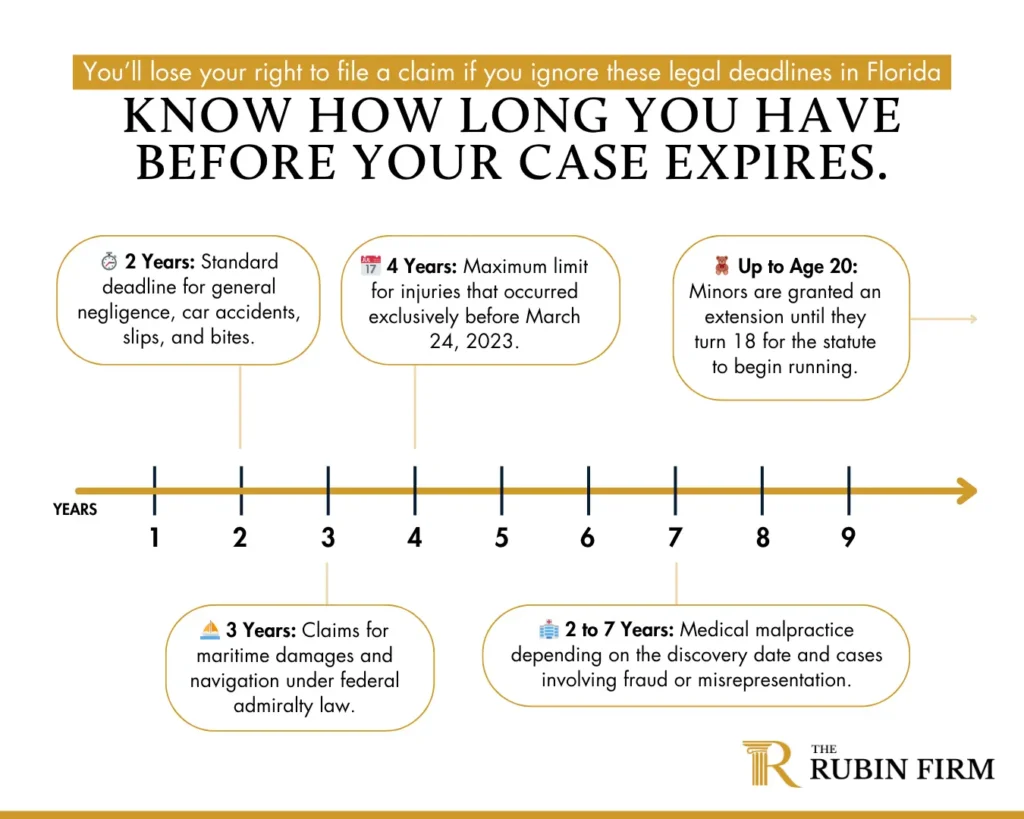
Before March 2023, Florida allowed four years for general negligence claims. The passage of House Bill 837 cut that window in half, aligning negligence claims with the two-year deadline that already applied to wrongful death cases. If your injury occurred before March 24, 2023, the four-year deadline may still apply. If it occurred after that date, you have two years. This is a crucial distinction that an attorney can help you navigate.
Special Deadlines for Specific Types of Claims
Not every injury claim follows the standard two-year rule. Medical malpractice claims in Florida must be filed within two years of when the injury was discovered, or should have been discovered through reasonable diligence, with an absolute outer limit of four years from the date of the malpractice in most circumstances. Cases involving fraud, concealment, or misrepresentation by the medical provider may extend that outer limit to seven years.
Claims against Florida government entities carry their own set of procedural requirements. You generally must provide written notice to the government agency before filing a lawsuit, and the overall timeline differs from private claims. Product liability claims follow the standard two-year negligence deadline, but the repose period for product-related injuries cuts off claims 12 years after the product was first sold, regardless of when the injury occurred. Boating and maritime injury claims may involve federal admiralty law with its own three-year statute of limitations, a distinction that matters in a coastal community like Stuart where recreational boating is part of daily life.
Exceptions That May Extend the Deadline
Florida law recognizes a handful of situations where the statute of limitations may be paused, or “tolled.” If the injured person is a minor, the clock does not start running until their 18th birthday, giving them until age 20 to file in most cases. If the injured person is mentally incapacitated and unable to manage their legal affairs, the statute may also be tolled during the period of incapacity.
The discovery rule applies in cases where the injury was not immediately apparent. For instance, if a surgical instrument was left inside your body during a procedure and you did not experience symptoms until a year later, the statute of limitations may begin on the date you discovered the injury rather than the date of the surgery. However, courts interpret these exceptions narrowly. Relying on a tolling argument without solid evidence is risky, which is why consulting an attorney sooner rather than later is always the safer choice.
Why Waiting Hurts Your Case
Even if you are well within the statute of limitations, delay works against you. Physical evidence from the accident scene deteriorates or disappears. Surveillance camera footage is typically overwritten within 30 to 90 days. Witnesses move away, change phone numbers, or forget critical details. Medical records are easier to obtain and organize closer to the date of the incident. Your Stuart personal injury lawyer needs time to investigate, gather evidence, and build the strongest possible case before negotiating with the insurance company or filing in court.
Insurance companies also gain leverage when you wait. A delayed claim signals to the adjuster that your injuries may not be as serious as you say, or that you are not motivated enough to follow through. Starting the legal process early sends the opposite message: you are serious, you are organized, and you are represented by counsel. Many of our clients at The Rubin Firm tell us they wish they had called sooner. The relief of knowing someone is handling the legal side while you recover is something you cannot put a price on.
The Clock Is Running on Your Florida Injury Claim

Florida gives you a limited window to pursue compensation after an injury. Every day that passes without legal action is a day that evidence fades, deadlines approach, and insurance companies strengthen their position. The attorneys at The Rubin Firm have spent over sixty years protecting the rights of injury victims in Stuart, Martin County, and across the Treasure Coast. We understand how these deadlines work and how to move quickly without sacrificing the quality of your case.
Call us today at (772) 283-2004, fill out our online contact form, or start a live chat on our website. Your consultation is free, and you pay nothing unless we recover compensation for you.
Frequently Asked Questions
What happens if I miss the statute of limitations in Florida?
If you file your lawsuit after the statute of limitations has expired, the defendant will file a motion to dismiss, and the court will almost certainly grant it. There are very few exceptions, and courts enforce these deadlines strictly. Once your right to sue is lost, it cannot be recovered.
Does the statute of limitations apply to insurance claims too?
The statute of limitations governs lawsuits filed in court. Insurance claims have their own timelines dictated by your policy terms. However, the threat of a lawsuit is what gives your insurance claim leverage, so letting the statute expire effectively eliminates your bargaining power with the insurer as well.
Can I still file a claim if my injury showed up weeks after the accident?
Yes, as long as you file within the statute of limitations period. Delayed symptoms are common in car accident cases, particularly for soft tissue injuries, concussions, and herniated discs. What matters is that you seek medical attention as soon as symptoms appear and that your physician documents the connection between the accident and your injury.
Does the two-year deadline apply to children injured in accidents?
For minors, the statute of limitations is generally tolled until the child turns 18. This means a child injured at age 10 would have until age 20 to file a lawsuit. Parents or legal guardians can also file on behalf of the child before the child reaches adulthood.
Should I wait to see how my injuries develop before contacting an attorney?
No. You can and should contact an attorney as soon as possible after your injury. An early consultation does not mean you have to file a lawsuit immediately. It means your attorney can begin preserving evidence, advising you on medical treatment, and protecting your rights while you focus on recovery.