



The value of a personal injury case in Florida depends on several factors, including the severity of your injuries, the total cost of your medical treatment, your lost wages and future earning capacity, the degree of the other party’s negligence, and the available insurance coverage. Florida follows a modified comparative negligence standard under Florida Statute § 768.81, which means your compensation can be reduced by your percentage of fault, and you are barred from recovery if you are found more than 50% responsible. While no attorney can guarantee a specific dollar amount, an experienced Florida personal injury lawyer can evaluate your damages and build a claim designed to maximize your recovery.
Read on to understand the types of damages available, the methods used to calculate them, and the factors that increase or decrease case value. If you need a personalized evaluation of your claim, the personal injury attorneys at The Rubin Firm in Stuart, Florida offer free consultations.
Key Takeaways
- Two categories of damages drive case value: economic damages (medical bills, lost wages, property damage) and non-economic damages (pain and suffering, emotional distress, loss of enjoyment of life).
- Florida’s comparative negligence rule can reduce your award by the percentage of fault assigned to you, and bars recovery entirely if you are more than 50% at fault. For instance, if you are found to be 25% at fault, your recovery is reduced by 25%.
- nsurance policy limits play a major role in what you can actually recover, regardless of how much your claim is worth on paper.
- Serious and permanent injuries dramatically increase case value because they involve higher medical costs, longer recovery periods, and greater impact on your daily life.
Economic Damages: The Numbers You Can Calculate
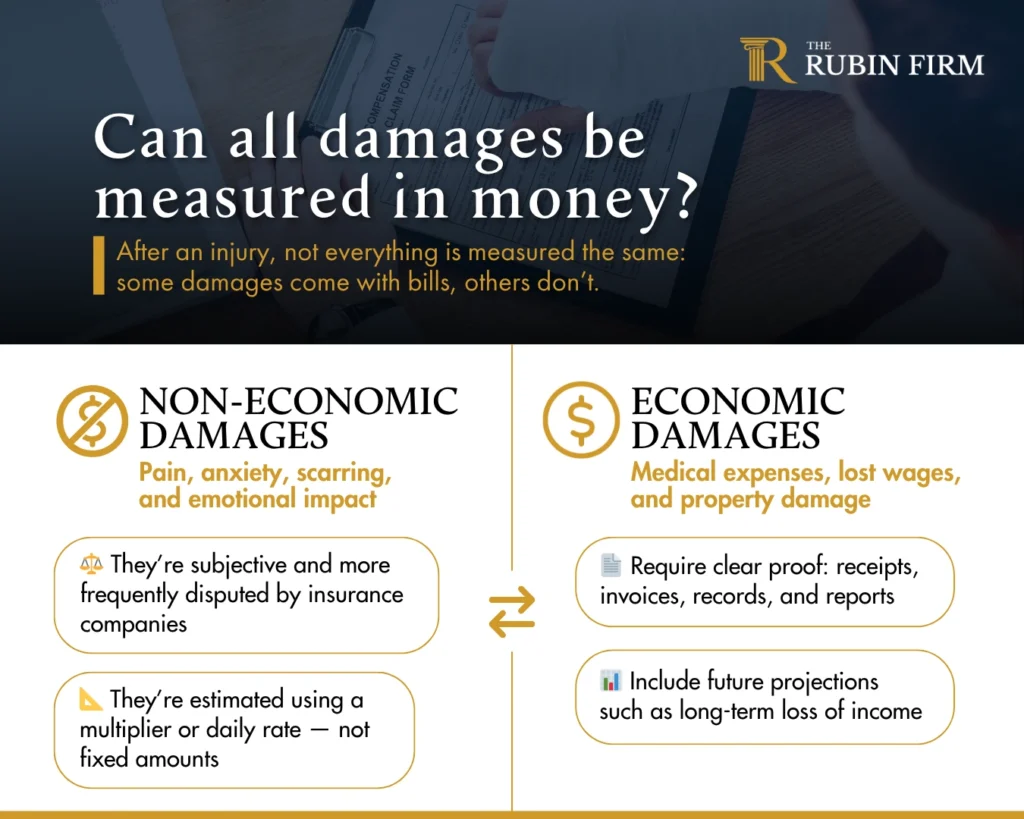
Economic damages are the tangible, measurable financial losses that flow directly from your injury. These are the numbers backed by receipts, invoices, pay stubs, and expert projections. Courts and insurance companies take them seriously because they are provable.
Medical expenses make up the largest portion of most claims. This includes emergency room visits, hospital stays, surgeries, diagnostic imaging, prescription medications, physical therapy, and any future medical treatment your doctors have recommended. Lost wages cover the income you missed while recovering, and if your injuries affect your ability to work long term, an economist can project your diminished future earning capacity. Property damage, typically the cost to repair or replace your vehicle, rounds out the economic category.
The key here is documentation. Every dollar you claim must be supported by evidence. Medical records, billing statements, employer verification letters, and expert reports all factor into the calculation. A gap in your medical treatment or missing documentation gives the insurance company an opening to argue your damages are exaggerated.
Non-Economic Damages: Putting a Dollar Amount on Pain
Non-economic damages compensate you for losses that do not come with a price tag: physical pain, emotional distress, anxiety, depression, scarring, disfigurement, loss of enjoyment of life, and the strain your injuries place on your relationships. These damages are subjective, which makes them both valuable and heavily disputed.
Insurance companies typically use one of two methods to estimate non-economic damages. The multiplier method takes your total economic damages and multiplies them by a factor between 1.5 and 5, depending on the severity of your injuries. A soft tissue injury that resolves within a few months might warrant a multiplier of 1.5 or 2. A traumatic brain injury or spinal cord damage requiring lifelong care could justify a multiplier of 4 or 5. The per diem method assigns a daily dollar amount for every day you live with pain from the date of injury through maximum medical improvement. Both methods serve as starting points for negotiation, not guarantees.
How Florida's Comparative Negligence Law Affects Your Recovery
Florida’s modified comparative negligence statute changed the landscape for personal injury claimants in 2023. Under the current law, a jury assigns a percentage of fault to each party involved in the accident. If you are found 20% responsible for the crash, your total award is reduced by 20%. If you are found more than 50% at fault, you recover nothing.
This is one of the most critical factors in case valuation because it directly reduces your bottom line. Insurance adjusters aggressively look for ways to shift blame onto you, whether it is arguing you were speeding, distracted, or failed to mitigate your injuries. A skilled Stuart personal injury attorney anticipates these arguments and builds evidence to minimize your share of fault.
Factors That Increase or Decrease Your Claim's Value
Not every car accident or slip and fall produces the same outcome. Several factors push case value higher or pull it down:
Severity and permanence of injuries.
A broken wrist that heals in six weeks is worth far less than a herniated disc requiring surgery and years of follow-up care.
Strength of liability evidence.
Clear proof of the other party’s negligence, such as a police report citing a traffic violation or surveillance video, increases your leverage in negotiations.
Insurance policy limits.
Even if your case is worth $500,000, you can only recover up to the at-fault party’s policy limits unless you pursue their personal assets. In Florida, the minimum liability coverage for bodily injury is just $10,000 per person.
Pre-existing conditions.
Insurance companies will argue that your current pain is actually from a prior injury. A good attorney counters this with medical evidence showing how the accident aggravated or worsened your pre-existing condition.
Credibility and consistency.
Gaps in medical treatment, inconsistent statements, or social media posts that contradict your claimed limitations can significantly reduce your claim’s value.
Find Out What Your Claim Is Really Worth

Calculating the value of a personal injury case requires more than plugging numbers into a formula. It takes a thorough understanding of Florida law, the ability to anticipate insurance company tactics, and the willingness to fight for every dollar you deserve. The attorneys at The Rubin Firm bring over sixty years of combined experience to every case we handle in Stuart, Martin County, and the Treasure Coast.
Do not guess at what your case might be worth. Call us at (772) 283-2004, fill out our online contact form, or start a live chat directly on our website. Your consultation is free, and you owe nothing unless we recover compensation for you.
Frequently Asked Questions
Can I get compensation if I was partially at fault for the accident?
Yes, as long as you are not more than 50% at fault. Florida’s modified comparative negligence system reduces your award proportionally. For example, if your damages total $100,000 and you are found 30% at fault, you would recover $70,000.
What is the average settlement for a personal injury case in Florida?
There is no meaningful “average” because every case is different. A minor fender bender with soft tissue injuries might settle for a few thousand dollars, while a catastrophic injury case can result in a multi-million dollar recovery. The value depends entirely on your specific injuries, treatment, and the facts of the case.
How long does it take to settle a personal injury case in Florida?
Most personal injury cases in Florida settle within six months to two years, though complex cases involving severe injuries, disputed liability, or multiple parties can take longer. Your attorney should not rush a settlement before you have reached maximum medical improvement, because settling too early risks leaving money on the table.
Do I have to pay taxes on my personal injury settlement?
In most cases, compensation for physical injuries and medical expenses is not taxable under federal law. However, portions of a settlement allocated to punitive damages, lost wages, or emotional distress unrelated to a physical injury may be subject to taxation. Consult a tax professional for advice specific to your situation.
Will my case go to trial?
The majority of personal injury cases settle before trial. However, having an attorney who is prepared and willing to go to trial gives you stronger negotiating leverage. Insurance companies know which firms take cases to court and which firms accept lowball offers.