



The penalties for a DUI in Florida vary based on the number of prior offenses, your blood alcohol concentration (BAC) at the time of arrest, and whether the incident involved property damage, injuries, or death. A first-time DUI conviction can result in up to six months in jail, fines between $500 and $1,000, a license suspension of 180 days to one year, up to 50 hours of community service, and mandatory DUI school. Penalties escalate sharply with each subsequent offense, and a third DUI within 10 years becomes a felony under Florida Statute § 316.193. Beyond the criminal penalties, a DUI conviction triggers long-term financial consequences that can total tens of thousands of dollars.
Read on to understand exactly what you face at each level of offense, the hidden costs most people overlook, and the defense options available to you. If you have been charged with a DUI in Stuart, Martin County, or the Treasure Coast, the criminal defense attorneys at The Rubin Firm can evaluate your case and protect your rights.
Key Takeaways
- A first-time DUI in Florida carries up to 6 months in jail, fines up to $1,000 (or $2,000 if blood/breath alcohol level is .15 or higher or there was a minor in the car), a license suspension, community service, and mandatory DUI school.
- Penalties increase dramatically for repeat offenses, with a third DUI within 10 years classified as a third-degree felony carrying up to 5 years in prison.
- Aggravating factors raise penalties significantly: a BAC of 0.15% or higher, having a minor in the vehicle, or causing serious bodily injury or death all trigger enhanced sentencing.
- The total financial cost of a Florida DUI often exceeds $10,000 when you factor in fines, court costs, DUI school, ignition interlock devices, and years of increased insurance premiums.
First-Time DUI Penalties in Florida
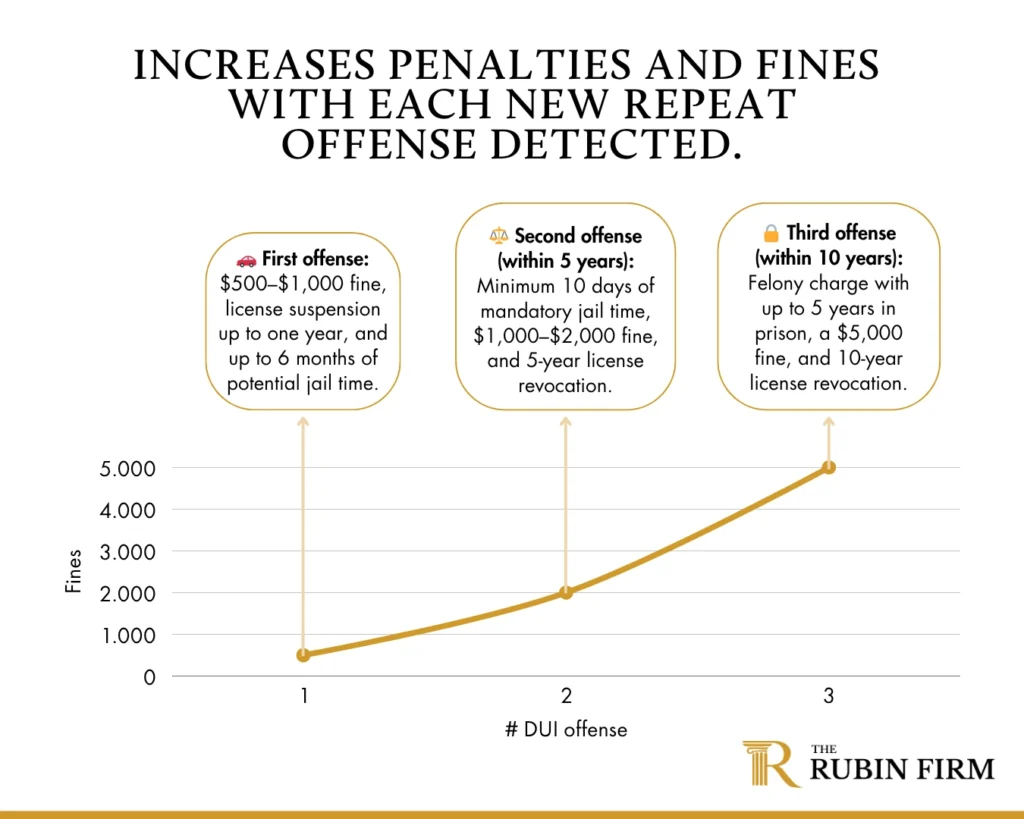
A first DUI offense in Florida is typically charged as a misdemeanor. The court may impose a jail sentence of up to six months, though many first-time offenders receive probation instead. Fines range from $500 to $1,000, and the judge will order between 180 days and one year of license suspension. You will also be required to complete a minimum of 50 hours of community service, attend a DUI education course, and may be ordered to install an ignition interlock device (IID) on your vehicle for up to six months.
If your BAC was 0.15% or higher, or if you had a minor under the age of 18 in the vehicle, the penalties jump. Fines increase to between $1,000 and $2,000, potential jail time extends to nine months, and an IID installation becomes mandatory for at least six months. These enhanced penalties reflect how seriously Florida treats aggravated DUI situations.
Second and Third DUI Offenses
A second DUI conviction within five years of the first carries a mandatory minimum of 10 days in jail, with at least 48 hours of consecutive confinement. Fines range from $1,000 to $2,000, and your license will be revoked for a minimum of five years, though you may be eligible for a hardship license after one year. An ignition interlock device is mandatory for at least one year.
A second DUI more than five years after the first carries slightly reduced mandatory minimums but still results in significant penalties, including fines, license revocation, and an IID requirement. Regardless of the timing, a second conviction puts you squarely on the court’s radar for enhanced sentencing if there is ever a third.
A third DUI within 10 years crosses the line from misdemeanor to third-degree felony. That means up to five years in state prison, up to $5,000 in fines, a mandatory minimum of 30 days in jail, and a license revocation of at least 10 years. A third DUI more than 10 years after the second is still a misdemeanor but carries up to 12 months in jail and fines between $2,000 and $5,000. A fourth DUI at any time is always a felony.
DUI Involving Serious Injury or Death
When a DUI causes serious bodily injury to another person, the charge elevates to a third-degree felony punishable by up to five years in prison, five years of probation, and a $5,000 fine. DUI manslaughter, where the impaired driving results in someone’s death, is a second-degree felony carrying up to 15 years in prison. If the driver knew or should have known the crash occurred and failed to provide aid or give information at the scene, the charge escalates further to a first-degree felony with a mandatory minimum of four years in prison and a maximum of 30 years.
The Hidden Financial Costs of a Florida DUI
The fines imposed by the court are only the beginning. A DUI conviction triggers a cascade of financial consequences that most people do not anticipate. Insurance premiums increase by an average of 60% or more annually, and that increase can persist for up to 10 years. DUI school costs between $200 and $500. An ignition interlock device runs approximately $70 to $150 per month for installation and monitoring. Court costs, administrative fees, and the cost of license reinstatement add several hundred more.
Factor in the potential loss of income from jail time, the cost of alternative transportation during your license suspension, and the impact a criminal record has on your employment prospects, and the total cost of a first-time DUI in Florida can easily exceed $10,000 to $15,000. For repeat offenders, the numbers climb much higher. An experienced Stuart DUI defense attorney may be able to challenge the charges, negotiate reduced penalties, or pursue alternative sentencing options that minimize these long-term consequences.
Your Future Is Worth Fighting For

A DUI charge in Florida is serious, but it is not a foregone conclusion. The prosecution must prove every element of the offense beyond a reasonable doubt, and there are often legitimate defenses available that can change the outcome of your case. The criminal defense attorneys at The Rubin Firm bring decades of courtroom experience to every case we handle in Stuart, Martin County, and the Treasure Coast. We understand the local courts, the local prosecutors, and the strategies that produce results.
If you or someone you love has been charged with a DUI, call us at (772) 283-2004, fill out our online contact form, or start a live chat on our website. Your consultation is free and confidential.
Frequently Asked Questions
Can I refuse a breathalyzer test in Florida?
You can, but there are consequences. Florida’s implied consent law means that by driving on Florida roads, you have already consented to chemical testing if lawfully arrested for DUI. Refusing a breathalyzer results in an automatic one-year license suspension for a first refusal and an 18-month suspension for a second refusal. A second refusal is also a misdemeanor criminal offense.
Will a DUI show up on my criminal record permanently?
Yes. Unlike some states, Florida does not allow DUI convictions to be expunged or sealed. A DUI will remain on your criminal record permanently, which can affect employment, housing applications, professional licensing, and immigration status.
Can I get a hardship license after a DUI in Florida?
In many cases, yes. A hardship license allows you to drive for work, school, medical appointments, and other essential purposes during your suspension period. Eligibility depends on the specifics of your case, and you must typically complete DUI school and apply through the Florida Department of Highway Safety and Motor Vehicles.
What if I was arrested for DUI but not over the legal limit?
Florida law does not require that your BAC exceed 0.08% for a DUI conviction. If law enforcement determines that your normal faculties were impaired by alcohol or drugs, you can be charged regardless of your BAC. This includes impairment from prescription medications, marijuana, and other controlled substances.
How can a criminal defense attorney help with a DUI charge?
An attorney can challenge the legality of the traffic stop, the accuracy of field sobriety tests, the calibration and administration of the breathalyzer, and the procedures followed during your arrest. Procedural errors by law enforcement can result in evidence being suppressed or charges being reduced or dismissed entirely.