

Name, image, and likeness (NIL) contracts allow college and high school athletes in Florida to earn money from endorsements, sponsorships, social media partnerships, and school revenue-sharing agreements without losing their eligibility. However, the NIL landscape in 2026 is far more complex than it was when the NCAA first permitted these deals in 2021. The NCAA’s evolving NIL framework, the House v. NCAA settlement, and the emergence of school-level revenue-sharing contracts have introduced new legal risks that most athletes and their families are not equipped to evaluate on their own. Florida athletes need to understand what they are signing, what rights they are giving up, and when to involve a sports attorney before the ink dries.
Below, we break down the current state of NIL contracts, the red flags to watch for, and why having your own legal counsel is different from relying on an agent or a school compliance office. The sports and entertainment attorneys at The Rubin Firm in Stuart advise athletes at every level on contract review and negotiation.
Key Takeaways
- NIL deals come in many forms: brand endorsements, social media partnerships, appearances, group licensing agreements, and school revenue-sharing contracts each carry different legal implications.
- Revenue-sharing contracts are the new frontier. These school-level agreements can include transfer restrictions, buyout clauses, and rights to your NIL that extend beyond what most athletes expect.
- An agent finds deals. A lawyer protects your future. Both serve important but fundamentally different roles, and relying on one without the other leaves gaps in your coverage.
- Every NIL contract must be reported. The College Sports Commission has made clear that deals labeled as “agency agreements” or “services agreements” are still NIL contracts if they involve payment for your name, image, or likeness.
The Difference Between Third-Party NIL Deals and Revenue Sharing
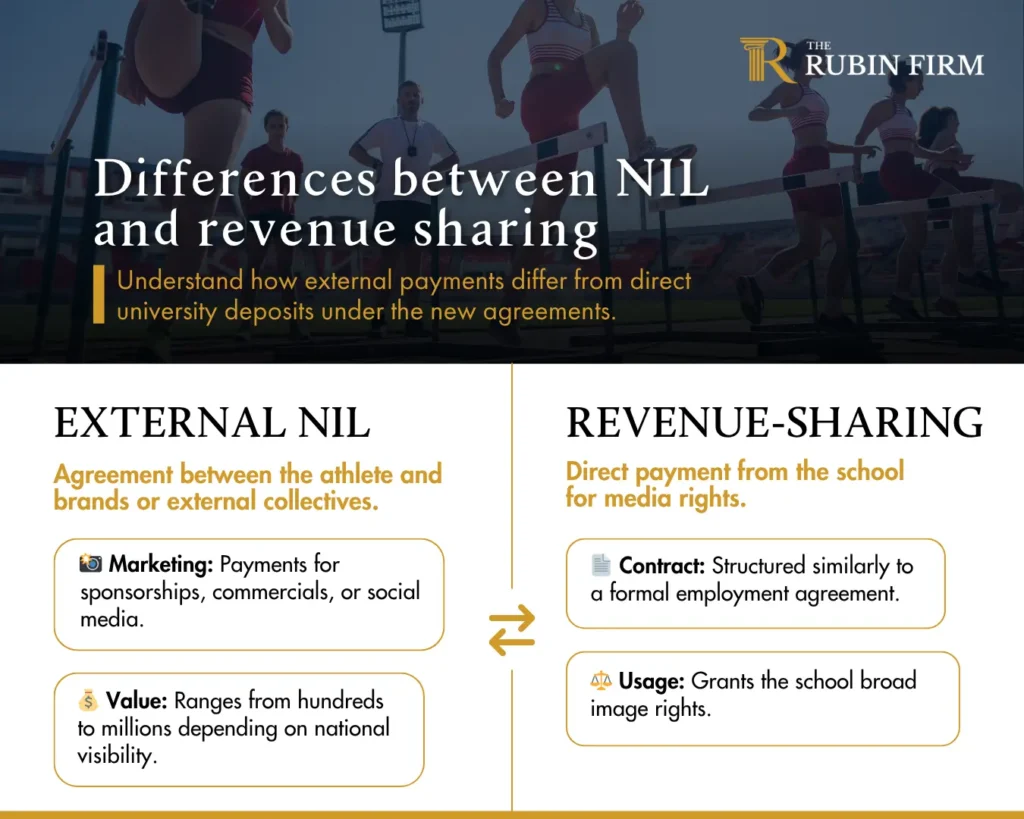
Third-party NIL deals are agreements between an athlete and an outside brand, company, collective, or individual. These are the sponsorship and endorsement deals that defined the early years of NIL: a local car dealership pays a quarterback to appear in a commercial, a sports drink company partners with a volleyball player for social media posts, or a collective pools donor money to distribute to athletes at a specific school. The value of these deals ranges from a few hundred dollars for a single social media post to multi-million-dollar packages for elite athletes with large followings and national visibility.
Revenue-sharing agreements are a newer development that emerged from the House v. NCAA settlement. Under these contracts, schools can pay athletes directly from a benefits pool funded by media rights revenue, ticket sales, and other institutional income. These agreements look less like endorsement deals and more like employment contracts, often including provisions that restrict the athlete’s ability to transfer, grant the school broad rights to use the athlete’s NIL, and impose financial penalties if the athlete leaves before the contract expires. Recent high-profile disputes involving college quarterbacks and their schools have brought these buyout provisions into the national spotlight, raising questions about enforceability that courts are only beginning to answer.
Red Flags Every Athlete Should Watch For
Not every NIL contract is a good deal, even if the dollar amount looks attractive. Contracts are drafted by attorneys whose job is to protect the brand or the school, not you. Some of the most common red flags athletes encounter include:
Overly broad rights grants.
Some contracts give the brand or school the right to use your name, image, and likeness in any way they choose, for any purpose, indefinitely. You should always know exactly how, where, and for how long your NIL will be used.
Non-compete or exclusivity clauses.
These provisions can prevent you from signing deals with competing brands, even if those competing offers are significantly more valuable. The scope and duration of any exclusivity clause should be narrowly tailored.
Buyout and liquidated damages provisions.
Revenue-sharing contracts frequently include clauses requiring athletes to pay back money if they transfer. The enforceability of these provisions is still being tested in courts, but signing one without understanding the financial exposure is a serious risk.
Morality or conduct clauses.
These clauses allow the brand or school to terminate your contract or withhold payment based on subjective judgments about your behavior. The language should be specific, not open-ended.
Why Athletes Need a Lawyer, Not Just an Agent
Agents are deal finders. Their job is to build relationships, identify opportunities, and generate revenue. A good agent brings value by connecting you with the right brands and negotiating the business terms of your deals. But agents are not trained to dissect contract language, identify hidden legal risks, or protect your long-term interests when the terms on paper do not match the promises made in conversation.
A sports attorney reviews every clause in the contract with one question in mind: what is the athlete giving up? Termination rights, indemnification clauses, intellectual property ownership, dispute resolution provisions, and post-contract restrictions all carry legal consequences that most athletes do not recognize. Schools and brands have lawyers drafting these agreements to protect their interests. Athletes deserve the same level of protection on their side of the table. The sports and entertainment attorneys at The Rubin Firm routinely review NIL contracts for athletes across Florida and can identify problems before they become costly disputes.
Protect Your Name, Your Brand, and Your Career

The NIL era has created extraordinary opportunities for Florida athletes, but those opportunities come with legal complexity that did not exist five years ago. Revenue-sharing contracts, transfer restrictions, and evolving NCAA enforcement make it more important than ever to have legal counsel in your corner. Whether you are a college starter fielding seven-figure offers or a high school athlete considering your first brand deal, the sports and entertainment attorneys at The Rubin Firm understand the business of athletics and the contract structures that drive it.
Call us at (772) 283-2004, fill out our online contact form, or start a live chat on our website. Your consultation is free.
Frequently Asked Questions
Do high school athletes in Florida have NIL rights?
Yes. Florida does not prohibit high school athletes from entering NIL agreements, and the NIL marketplace has increasingly expanded to include high school athletes with significant social media followings or competitive profiles. However, contracts involving minors require parental consent and raise additional legal considerations, including whether earnings should be placed in a protected trust account.
Do I have to report my NIL deals to my school?
Yes. The College Sports Commission requires that all third-party NIL contracts valued at $600 or more be reported through the NIL Go platform within the established deadline. Failure to report can jeopardize your eligibility, regardless of how the contract is labeled.
Can my school force me to sign a revenue-sharing contract?
Schools cannot force athletes to sign revenue-sharing agreements, but the practical reality is that athletes who decline may miss out on significant compensation. Before signing, have your own attorney review the contract to ensure the terms are fair and that you understand the transfer restrictions and financial obligations involved.
What happens if I breach an NIL contract?
The consequences depend on the terms of the agreement. Breaching a third-party deal could result in the brand seeking damages or withholding payment. Breaching a revenue-sharing contract with your school could trigger liquidated damages provisions requiring you to return money already received. These disputes are increasingly being litigated in court, and having legal representation from the start is the best way to avoid or manage them.
How much does it cost to have a lawyer review an NIL contract?
Contract review fees vary, but they are a fraction of the financial exposure you face if you sign a bad deal. Many sports attorneys offer flat-rate contract review services. The cost of a legal review is an investment in protecting your earning potential, your eligibility, and your future.